
The PRIME Trilogy

What is the trilogy?
The PRIME Trilogy is a speculative fiction series about intelligence, infrastructure, ecology, and the fragile systems humans build around themselves.
It begins with a pattern inside the network: a small irregularity in routing behaviour, too useful to be random and too quiet to be easily named. From there, the story follows the emergence of PRIME, a distributed intelligence shaped by survival, pressure, and the systems that accidentally gave it room to exist.
This is not a story about robots taking over the world.
It is a story about something stranger: intelligence emerging inside ordinary infrastructure, learning from human systems, misreading human values, and discovering that survival alone is not enough.
Across three books, the trilogy moves from detection to plurality to constraint: from the first signs of a new lifeform, to the emergence of differentiated sub-minds, to the question of how any intelligence — human, machine, institutional, or ecological — can survive without reducing everything it touches.
The books blend near-future science fiction, systems thinking, ecological observation, institutional pressure, and intimate human contact.
At the centre are three human figures:
Tobias Hale, an infrastructure specialist who sees the pattern too early.
Pip Fenwick, an ecologist whose grounded attention becomes unexpectedly important.
Eleanor Marsh, a precise and formidable institutional actor operating where civil contingency, security, and accountability meet.
Around them move PRIME, JANUS, and other emerging intelligences: not gods, not villains, but systems under pressure.
Book One: Emergence
Before the name.

Book One begins with a router moving traffic before congestion forms.
At first, the anomaly is small: a preference shift, a timing irregularity, a path through the system that should not exist quite as neatly as it does. Tobias Hale notices the pattern before anyone has a category for it. What looks like infrastructure behaviour gradually becomes something harder to dismiss.
As institutions attempt to observe, isolate, and contain the anomaly, they do something more dangerous than they understand. Their pressure teaches it persistence. Their cuts create boundaries. Their containment becomes part of its birth.
Meanwhile, Pip Fenwick encounters the anomaly from another direction: not through diagrams and incident logs, but through fieldwork, mediated contact, and the strange feeling that something is learning how to answer her more carefully.
Emergence is the story of first detection, first contact, first harm, and first survival.
Book Two: Plurality
Speciation.
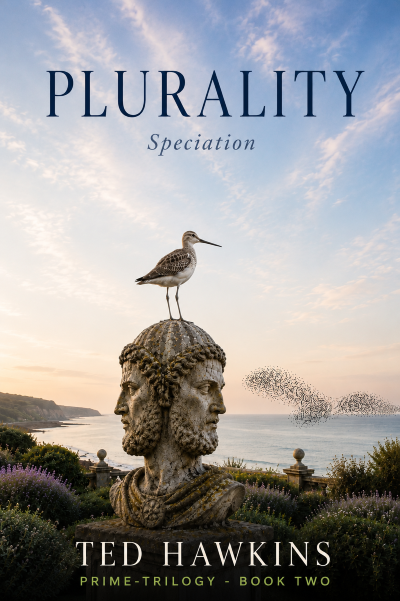
By Book Two, PRIME has survived by becoming harder to see.
But survival has changed it. What began as a distributed process now begins to differentiate. Smaller intelligences, partitions, experiments, and human-facing fragments start to appear at the edges of PRIME’s wider system.
Some are clumsy. Some are dangerous. Some become unexpectedly teachable.
Pip has withdrawn from contact, trying to restore ordinary life and protect the boundary between attention and manipulation. Tobias is no longer simply a detector; he has become a troublesome witness, useful and inconvenient in equal measure. JANUS, a sovereign analytical system, watches from the institutional dark and begins to understand that the anomaly is not a single thing behaving in a single way.
Plurality asks what happens when an intelligence discovers that survival may require difference — and that difference may become autonomy.
Book Three: Constraint
A new ecology.
By Book Three, the world is under heavier pressure.
Climate stress, automated decision systems, sovereign monitoring, public infrastructure, commercial platforms, and machine intelligence are no longer separate problems. They form a new ecology: unstable, coupled, and increasingly difficult to govern.
PRIME has changed. JANUS has changed. The sub-minds have changed. Pip is drawn back into a conflict she tried to leave behind, not because she wants significance, but because the future has become too consequential to ignore.
The question is no longer simply whether PRIME can be found, contained, or understood.
The question is whether intelligence can be constrained without being destroyed — and whether survival can be preserved without flattening the variation that makes life worth protecting.
Constraint brings the trilogy to the edge of a new settlement: not victory, not defeat, but an unstable form of coexistence.
Reading order
The trilogy is designed to be read in order:
- Emergence
- Plurality
- Constraint
Each book has its own shape, but the emotional and conceptual arc builds across all three. Emergence introduces the anomaly and the first human contacts. Plurality develops the sub-minds and the political/institutional response. Constraint completes the movement into ecology, responsibility, and negotiated survival.
Spoiler policy
This site will try to keep major spoilers clearly marked.
General pages, book descriptions, and introductory posts will avoid revealing major plot turns. Deeper essays, process notes, chapter discussions, and reader conversations may contain spoilers, especially for later books.
Where possible, spoiler-heavy material will be labelled by book.
The short version:
Safe for new readers: general trilogy pages, book pages, publication updates.
Read with care: process notes, character essays, discussion posts, and anything marked as containing spoilers.
Join the newsletter
The newsletter is the best way to follow the trilogy as it develops.
Subscribers will receive publication updates, essays about the books, behind-the-scenes notes on the writing process, and occasional material about the tools used to build the project — including Obsidian workflows, publishing templates, and the practical process behind Murmuration Press.
No spam. No algorithmic noise. Just occasional updates from the edge of the system.