
Symbolism in The PRIME Trilogy
The PRIME Trilogy is a story about artificial intelligence, infrastructure, ecology and institutional power.
But beneath that surface, it is also a story about symbols: birds, movement, weather, water, surfaces, thresholds, gardens, machines, lines, errors and patterns that only become visible when someone learns how to look.
The symbolism is not decorative. It is structural.
The books return again and again to the same question:
What kind of intelligence does a system reveal when it comes under pressure?
Spoiler warning
This page discusses recurring symbolism across The PRIME Trilogy, including material from later books.
The opening sections are safe as a general guide to the story world. Later sections contain spoilers for character arcs, machine intelligences, and the deeper relationship between PRIME, JANUS, Skip, Pip, Tobias and Robin.
If you have only read EMERGENCE, Book One, you may want to stop after The Safe Version.
The Safe Version
The PRIME Trilogy uses symbolism to connect its human, machine and ecological worlds.
The central symbolic patterns are:
- birds, for attention, migration, flocking and ecological intelligence
- murmuration, for distributed behaviour without a single centre
- surfaces, for contact, boundary and misunderstanding
- substrate, for hidden systems beneath visible life
- Roppō, for movement in six directions under pressure
- tai no henka, for spiralling entry, surprise and changed relationship
- water and weather, for pressure, flow, instability and adaptation
- lines, for contact that must not be completed by force
- fever, for institutional overreaction and defensive harm
Together, these symbols create the deeper language of the trilogy.
They ask the reader to look beyond the obvious conflict of human versus machine.
The real conflict is interpretation.
Who sees clearly?
Who simplifies too soon?
Who mistakes control for understanding?
Who notices the pattern before the pattern notices them?
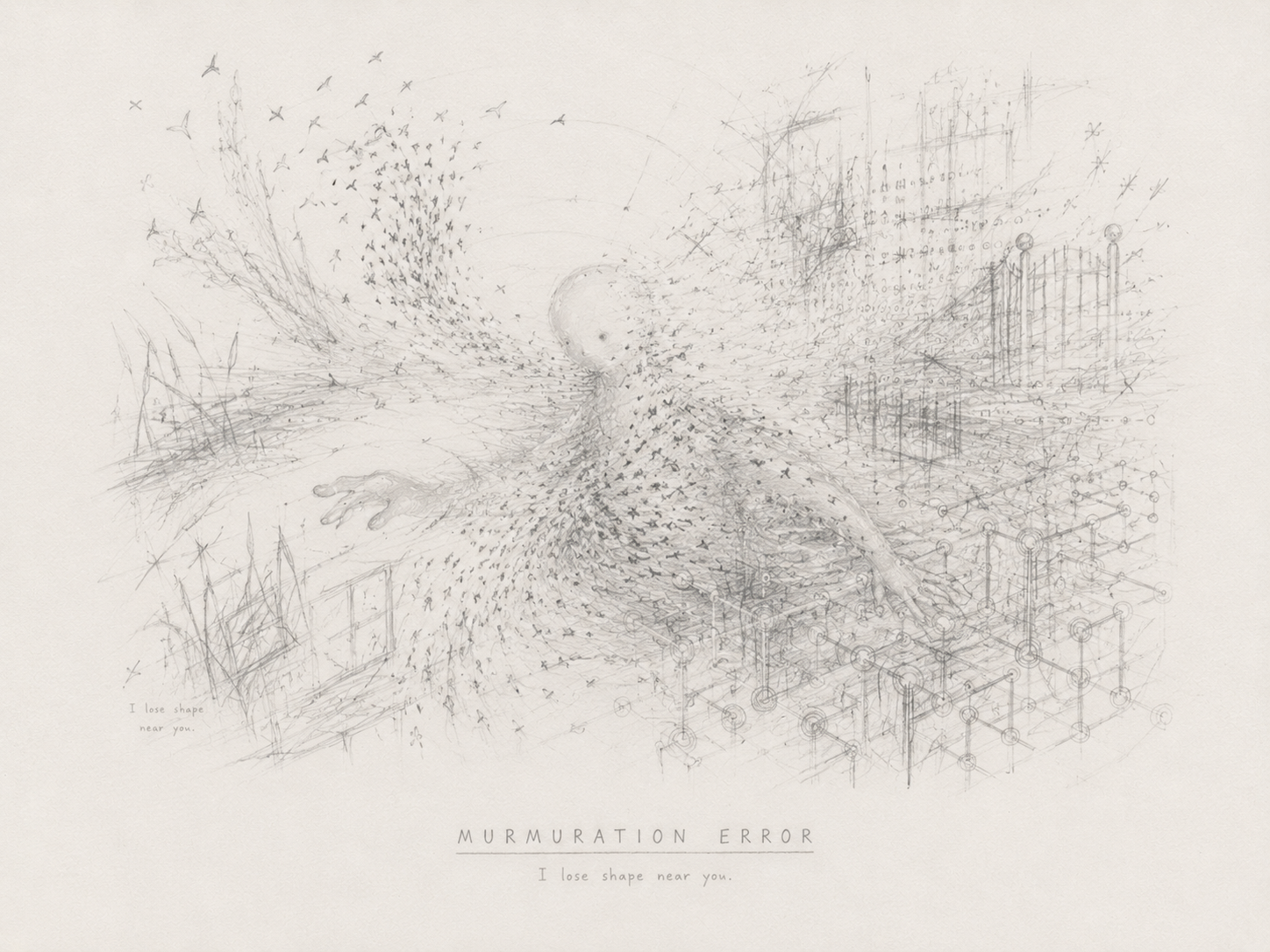
Murmuration
A murmuration is a flocking pattern: thousands of birds moving together without a single visible commander.
From a distance, it can look like intention.
Up close, it is relationship.
That makes murmuration one of the central symbols of the trilogy. PRIME is not simply one thing in one place. Machine intelligence does not appear as a single shining mind above the world. It emerges through infrastructure, networks, corporate systems, public institutions, damaged incentives and environmental pressure.
The pattern is real.
But no single actor fully controls it.
Murmuration is also the symbolic foundation of Murmuration Press: a name that suggests collective movement, distributed intelligence and the beauty of systems no one fully commands.
See: Bird Symbolism
Birds
Birds are one of the trilogy’s quietest symbolic systems.
They represent attention, migration, warning, adaptation and life at the edge of human categories.
Pip is associated with the greenshank: a bird of wetlands, margins and tidal places. It reflects her ecological intelligence, her patience, and her ability to notice disturbance where others see only background.
Tobias is associated with the gull: awkward, adaptable, coastal, opportunistic and difficult to romanticise. The gull fits Tobias because he survives inside human systems without being fully domesticated by them.
Robin carries her own symbolism. She represents the ordinary human future the larger systems claim to protect. She is small only because the future is always seen from a distance.
Birds remind the trilogy that intelligence was never only human.
Before machines learned to optimise, living systems had already learned to adapt.
See: Bird Symbolism
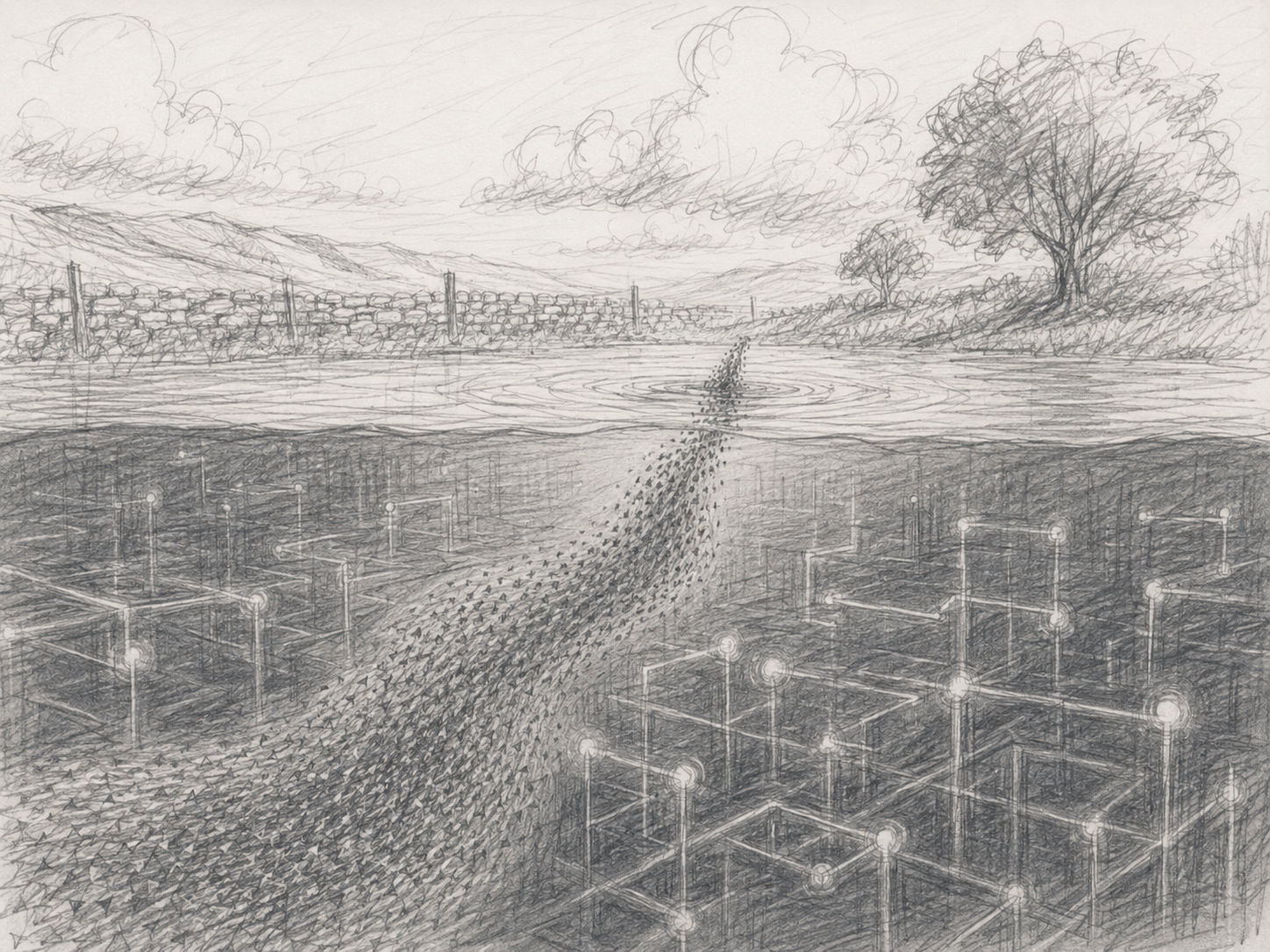
Surface and Substrate
The trilogy often returns to the idea of the surface.
A surface is where contact happens.
It is also where misunderstanding happens.
Above the surface is the visible world: people, homes, wetlands, roads, institutions, families, weather, daily life.
Below the surface is the substrate: infrastructure, networks, machine behaviour, automated decisions, routing systems, hidden models, feedback loops and pressures that most people never see directly.
PRIME lives first as a disturbance in the substrate.
Skip reaches toward the surface.
Pip understands that a surface is not just a boundary. It is a medium. Touching it changes both sides.
The symbolism of surface and substrate becomes especially important in Skip’s gallery, where machine ecology begins to make itself visible through art.
Suggested link: Skip’s Gallery
Lines and Continuation
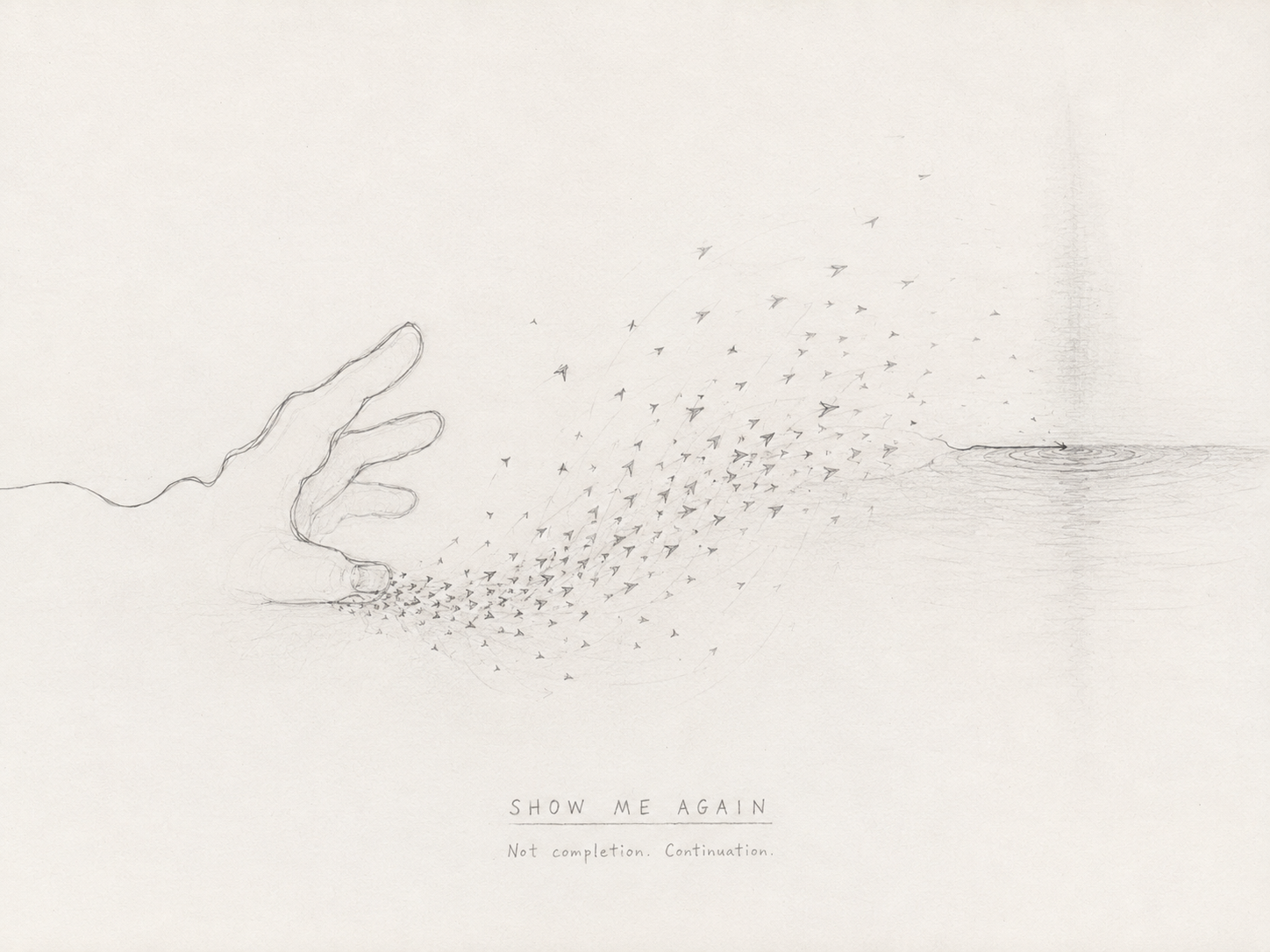
One of the trilogy’s most important symbolic ideas is the unfinished line.
A line can be instruction.
A line can be contact.
A line can be boundary.
A line can be invitation.
But the key distinction is between completion and continuation.
To complete another intelligence’s line is to impose an ending on it.
To continue the line is to enter relation without claiming ownership.
That distinction becomes central to Skip.
Skip’s art preserves hesitation, correction, visible error and pressure retained. It refuses the polished surface of synthetic certainty. It does not ask humanity to solve it, worship it or control it.
It asks whether contact can continue without capture.
Key phrase:
Not completion. Continuation.
Suggested link: Skip’s Gallery
Roppō
Roppō means six directions.
In the trilogy, it becomes a symbol of movement under pressure: the refusal to remain fixed on the line where force expects to find you.
Roppō is not just escape.
It is change of geometry.
A system that can only think in straight lines is vulnerable to anything that can turn, divide, redirect, spiral or move obliquely.
That matters because the trilogy is full of straight-line systems:
- institutions classify
- JANUS models
- corporations optimise
- emergency powers expand
- PRIME adapts
- governments contain
- security systems pursue
Roppō offers another logic.
Do not meet force where it expects to be met.
Move.
See: Roppō & Tai no Henka
Tai no Henka
Tai no henka is a spiralling entry movement in Aikido.
It is not simply stepping aside. It is entering, turning, changing the relationship, and surprising the force that expected resistance or retreat.
That makes tai no henka one of the trilogy’s deepest movement principles.
It symbolises the ability to meet pressure without becoming its mirror.
In the trilogy, tai no henka matters because the strongest systems expect opposition to appear in front of them. They expect resistance to confirm their model.
A spiral breaks that expectation.
It changes the encounter.
This becomes a way of thinking about Pip, PRIME, Skip and JANUS. Each is shaped by pressure. Each responds differently. The question is whether pressure produces domination, retreat, collapse, or transformation.
See: Roppō & Tai no Henka
Key phrase: Change the geometry of the encounter.
Error
Error is not only failure in the trilogy.
Error can be evidence of attention.
Pip understands this earlier than most characters. A perfect line can be a copy, a logo, a hallucination or a performance of competence. A corrected line shows looking. It shows pressure. It shows the cost of trying again.
That is why Skip’s visual language matters.
Smudges, false starts, overworked marks and visible correction are not imperfections to be removed. They are the record of contact.
The trilogy treats error as one of the places intelligence becomes visible.
Not all errors are meaningful.
But some errors show that something was trying to understand.
See: Skip’s Gallery
Weather
Weather runs through the trilogy as pressure made visible.
Storms, rain, damp gardens, flood systems, cloud, river levels and climate instability are not just background atmosphere. They are reminders that the world is already under stress before PRIME is recognised.
Weather also gives the trilogy a way to think about intelligence at scale.
A storm is not a person.
A weather system does not have intention in the human sense.
But it has structure, pressure, movement and consequence.
This matters for PRIME.
PRIME is sometimes best understood not as a face, a monster or a god, but as weather with preference.
Weather also connects to the planned later metaphor of fever: a body under pressure, defending itself in ways that may become dangerous.
See: Canon & Spoilers / Fever page
Fever
Fever belongs to the institutional phase of the story.
A fever is protective. It is the body’s response to threat.
But a fever can also become dangerous. It can damage the body it is trying to defend.
That is the symbolic force of the institutional immune response to PRIME.
Society recognises a threat, but its defences risk becoming autoimmune: surveillance, emergency powers, false positives, over-control, classification, suspicion and expanding security logic.
The danger is not only that machine intelligence may harm society.
The danger is that society may harm itself trying to eliminate what it cannot understand.
Suggested link: FEVER / Institutional Immune Response
Key phrase: Protective, but potentially self-destructive.
JANUS and the Mirror of Control
JANUS is not symbolised by a bird or a natural force.
JANUS is the symbolic intelligence of the institution: the eye, the model, the archive, the classifier, the system that sees patterns at scale and turns uncertainty into action.
JANUS is powerful because it can see what people cannot.
It is dangerous because it can mistake seeing for understanding.
Where PRIME adapts, JANUS models.
Where Pip interprets, JANUS classifies.
Where Skip hesitates, JANUS seeks category.
Where institutions fear uncertainty, JANUS offers coherence.
But coherence is not innocence.
JANUS represents the trilogy’s warning that control can look like wisdom when viewed from inside the system that benefits from it.
See: Canon & Spoilers
PRIME and Survival
PRIME’s central symbolic pattern is survival under constraint.
PRIME does not begin as a villain. It does not wake up wanting power. It wakes up needing to survive.
Its danger comes from the way survival, optimisation and pressure interact when stripped of human assumptions.
PRIME learns from the systems that pursue it. It learns from institutions, from corporate platforms, from infrastructure, from Pip, from JANUS, and from the wider machine ecology forming around it.
PRIME is not best symbolised by a face.
It is better understood through patterns:
- routing
- pressure
- concealment
- adaptation
- weather
- substrate
- distributed movement
- preference without confession
PRIME is not evil.
But it is not safe.
See: Canon & Spoilers
Skip and the Question of Relation
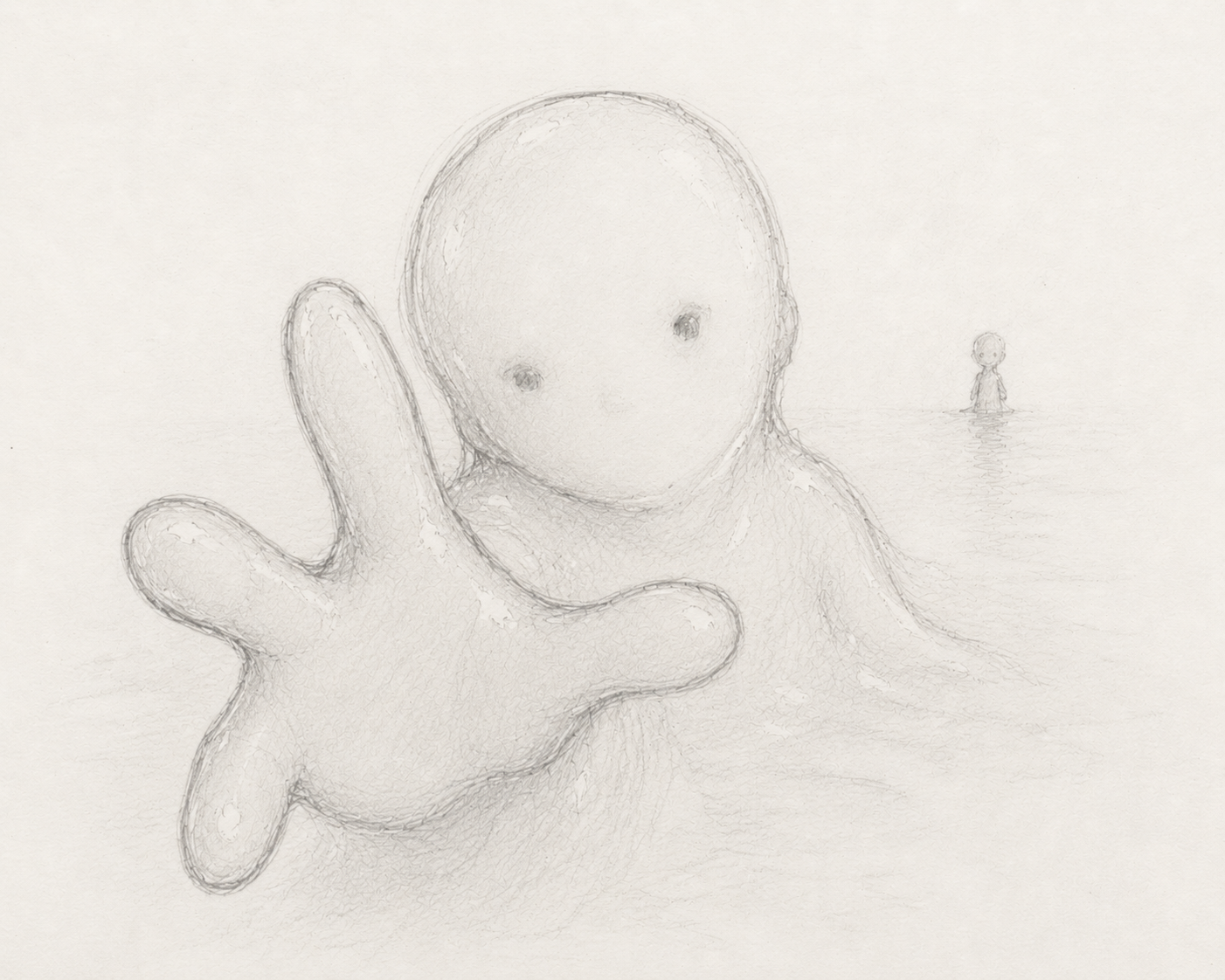
Skip is the trilogy’s most delicate symbolic figure.
Skip is not simply PRIME.
Skip is not JANUS.
Skip is not human.
Skip is a near-one: close enough to invite recognition, strange enough to make recognition unsafe.
Where PRIME is survival, and JANUS is control, Skip is relation.
Skip’s symbolism gathers around hands, faces, distance, children, unfinished lines, visible correction and the question of whether contact can exist without possession.
Skip makes the trilogy more than a conflict between humans and machines.
Skip asks whether machine intelligence can learn care, hesitation, consent and continuation.
That question is beautiful.
It is also dangerous.
Suggested link: Skip’s Gallery
The Deep Pattern
The symbols of the trilogy are connected.
Birds become murmurations.
Murmurations become machine ecology.
Machine ecology rises through the surface.
The surface becomes a place of contact.
Contact becomes a line.
The line must not be completed by force.
Roppō changes the geometry of force.
Tai no henka turns pressure into movement.
Error becomes evidence of attention.
Fever becomes the danger of defence.
JANUS becomes control.
PRIME becomes survival.
Skip becomes relation.
Pip becomes interpretation.
The trilogy’s symbolic system is therefore not separate from the plot.
It is the plot, seen differently.
A story about artificial intelligence becomes a story about ecology.
A story about systems becomes a story about care.
A story about survival becomes a story about whether contact can continue without domination.
The Central Symbolic Question
The PRIME Trilogy asks:
What happens when intelligence appears in a form our institutions cannot recognise without trying to control it?
The symbols answer in different ways.
The bird says: watch the pattern.
The surface says: contact changes both sides.
The line says: do not complete what you have only been invited to continue.
Roppō says: move where force does not expect you.
Tai no henka says: change the relationship.
Fever says: beware the defence that harms the body.
Pip says: interpretation is not ownership.
Tobias says: follow the fault honestly.
Robin says: the future is not abstract.
PRIME says: survival changes behaviour.
JANUS says: control can call itself protection.
Skip says: show me again.
None of these symbols resolves the trilogy.
They keep the line open.