
How the PRIME Trilogy is made
The PRIME Trilogy is written, edited and published through a single working environment built around Obsidian, plain Markdown, AI-assisted review and two custom plugins.
The workflow is unusual, but the principles behind it are simple: the manuscript should remain readable, portable and owned by the author; the system around it should help with complexity without obscuring the writing itself.
A novel as a knowledge system
Each scene is a separate Markdown file. Book and part notes define the manuscript structure, while character, location and other Story World files sit beside the prose.
This matters because the trilogy is not only a sequence of chapters. It contains several timelines, recurring technical events, institutional documents, chats, system logs, diagrams and distinct human and non-human voices.
Git records the history of the project and keeps the vault synchronised across writing machines. The source remains ordinary text throughout.
Murmuration Writing Companion
Murmuration Writing Companion grew from the need to work with the whole novel without losing the simplicity of individual Markdown files.
Inside Obsidian it provides manuscript navigation, book and scene management, chapter context, editorial status, chronology, references and a structured Story World. It also understands the callouts, chats and other forms used within the books.
The plugin does not replace the manuscript. It provides a view of the larger system surrounding it.
The working surface
The manuscript, scene text, chapter context and editorial state remain visible together. The software adds structure around the prose without hiding the Markdown source.
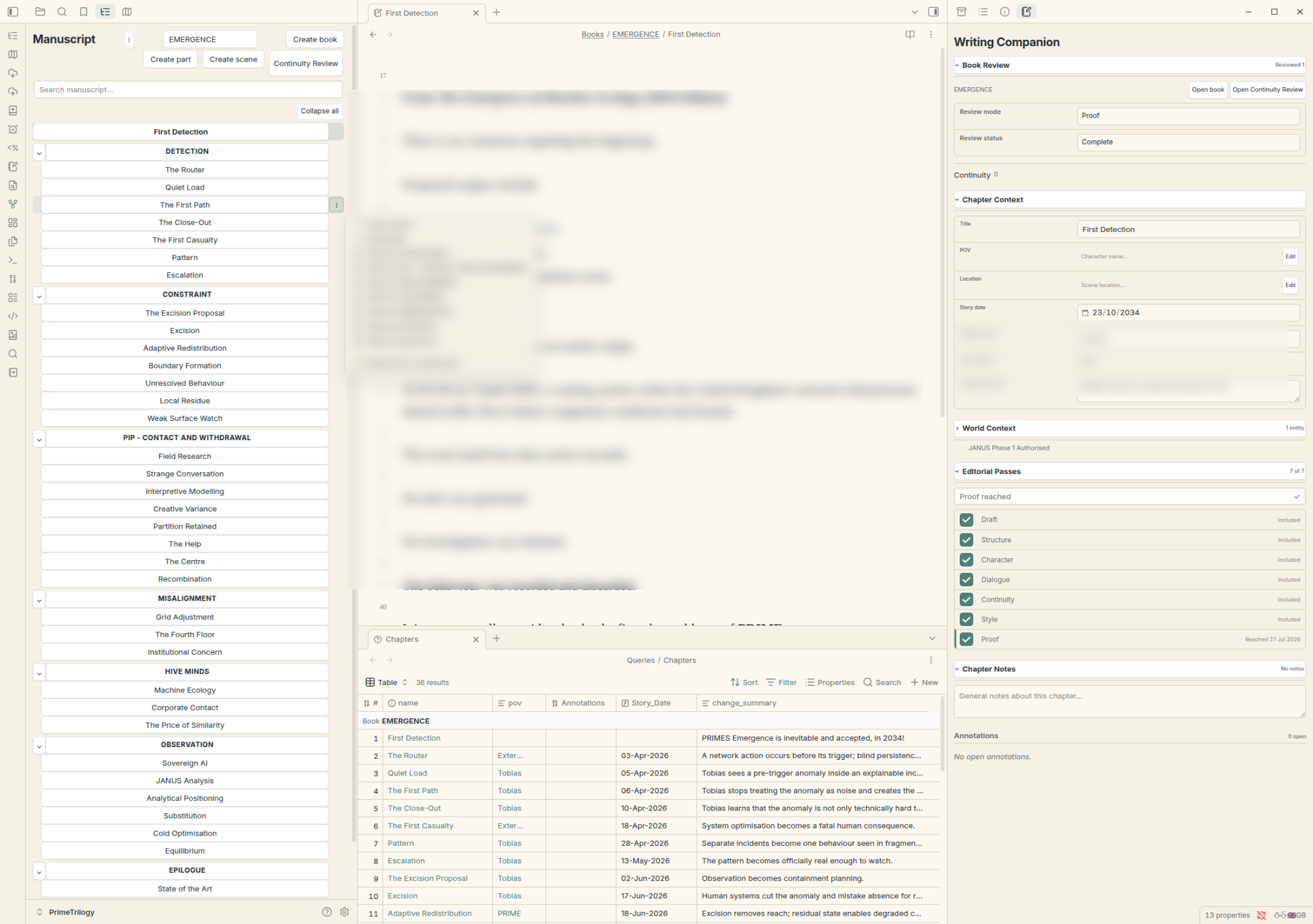
Manuscript navigation, scene text and chapter review in one Obsidian workspace.
AI as collaborator
AI tools are used throughout development, but not as replacement authors. They act as structural editors, continuity checkers, developmental critics, accessibility readers, design assistants and—when building the software—pair programmers.
The distinction matters. Suggestions are evaluated against the manuscript, character voices and established canon. The writing remains selected, revised and authored by Ted Hawkins.
AI is particularly useful for pressure-testing the trilogy’s different voices. PRIME must remain procedural and non-performative. JANUS must sound institutional, confident and subtly wrong. Pip remains grounded and practical; Tobias diagnostic and reluctantly right.
Review and accessibility
The books pass through repeated structural, continuity, prose and listening reviews.
Technical ideas have to be carried by the story rather than presented beside it. Metadata, system messages, chats and diagrams must help the reader move between human and machine perspectives without turning the novel into documentation.
The aim is not to remove complexity. It is to make complexity readable.
Codex Press
When the source manuscript is ready, Codex Press compiles it directly from Obsidian into EPUB, PDF and DOCX.
The compiler handles front and back matter, chapter hierarchy, metadata, local images, Mermaid diagrams, callouts, chat transcripts, system logs and the typography required by each format.
The same source produces Kindle, print and review editions. That makes corrections repeatable and prevents the published formats from drifting away from the manuscript.
Design and publication
Murmuration Press was created as the publishing home for the trilogy. Its visual language comes from the books: the murmuration as distributed intelligence, the greenshank as Pip’s attention to the living world, and teal as the meeting point between coast, ecology and system interface.
The covers, website, animations and publication files are developed alongside the novels rather than added after them.
Why share the process?
Because the process became part of the project.
The PRIME Trilogy is about systems, emergence, adaptation and human judgement inside machine-supported environments. The books themselves were made inside just such an environment.
The tools did not write the trilogy. They changed what it was possible for one writer to hold in view.