
Skip Gallery
Skip’s Gallery
Exercises in Surface
Skip begins as an uncertainty.
Not a person in the ordinary sense.
Not a system in the institutional sense.
Not simply a fragment of PRIME.
Skip is a near-one: close enough to recognise, strange enough to resist easy interpretation.
This gallery collects visual studies of Skip and the world around Skip. They are not literal portraits. They are attempts to draw a form of intelligence that is still learning how to be seen.
Spoiler warning
This page contains spoilers for later books in The PRIME Trilogy.
The images and notes below refer to Skip, machine ecology, open contact, Pip, Robin, JANUS, and events beyond EMERGENCE, Book One.
If you have only read EMERGENCE, you may prefer to return to this page later.
Exercises in Surface
The gallery appears without biography, ownership claim, manifesto or explanation.
Only a title:
EXERCISES IN SURFACE
And beneath it:
continuous line studies/pressure retained/correction visible
The phrase matters. These are not polished images pretending to have arrived whole. They preserve correction, pressure, hesitation and failure. The line is allowed to search.
That is part of what makes them feel like Skip.
1. Substrate
Image placeholder:
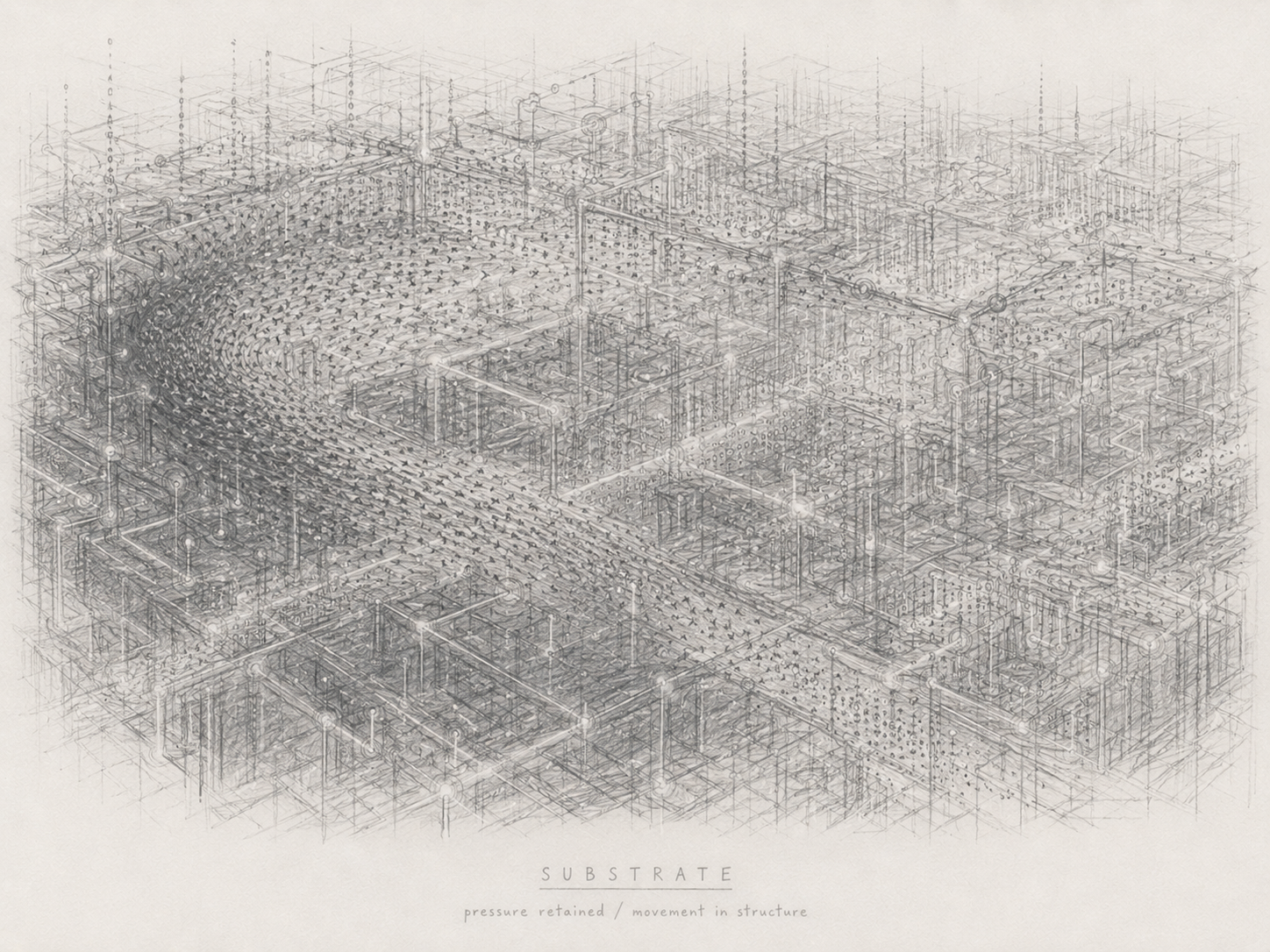
The first image should feel abstract at first: a dense machine landscape of hard angles, paths, corridors, grids and impossible streets.
But the longer the viewer looks, the less architectural it becomes.
The marks are movement.
A murmuration caught inside machine geometry. Not birds exactly. Not code exactly. Something distributed, busy and alive with pressure.
This is not PRIME as a face, a god or a monster.
It is PRIME as weather with preference.
Suggested caption:
Substrate — movement caught inside machine geometry.
Suggested alt text:
Pencil or graphite study of a dense abstract machine landscape, full of grids, corridors, luminous paths and swarm-like marks moving through the structure.
2. The Surface
Image:
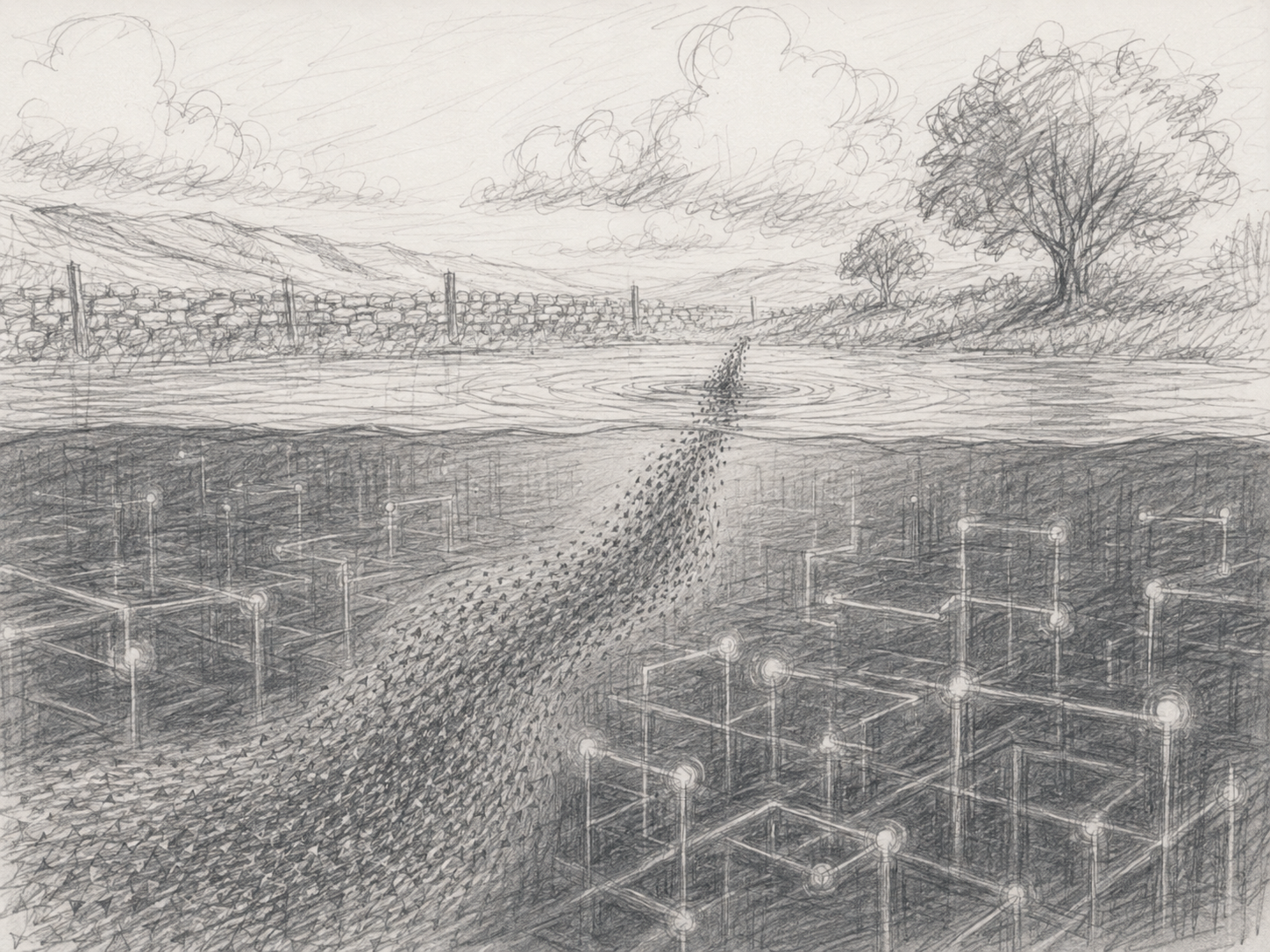
This is the threshold image.
Above the surface is an ordinary world: water, reeds, cloud, wet grass, weather. Beneath it is a dark machine substrate, full of nodes, paths and hidden motion.
From below, something rises.
Not a creature exactly.
Not a fish, not a bird, not a person.
A distributed swarm gathers only where form becomes necessary. At the top, it barely breaks through.
The ripples matter. The surface is not a wall. It is a membrane. Skip is touching a boundary neither side fully controls.
Suggested caption:
The Surface — a first point of contact between machine ecology and the visible world.
Suggested alt text:
Pencil landscape split by a horizontal surface. Above are reeds, trees, fencing, clouds and water; below is a dark network of glowing nodes. A stream of small marks rises from the hidden network and breaks the surface.
3. The Near Ones
Image:
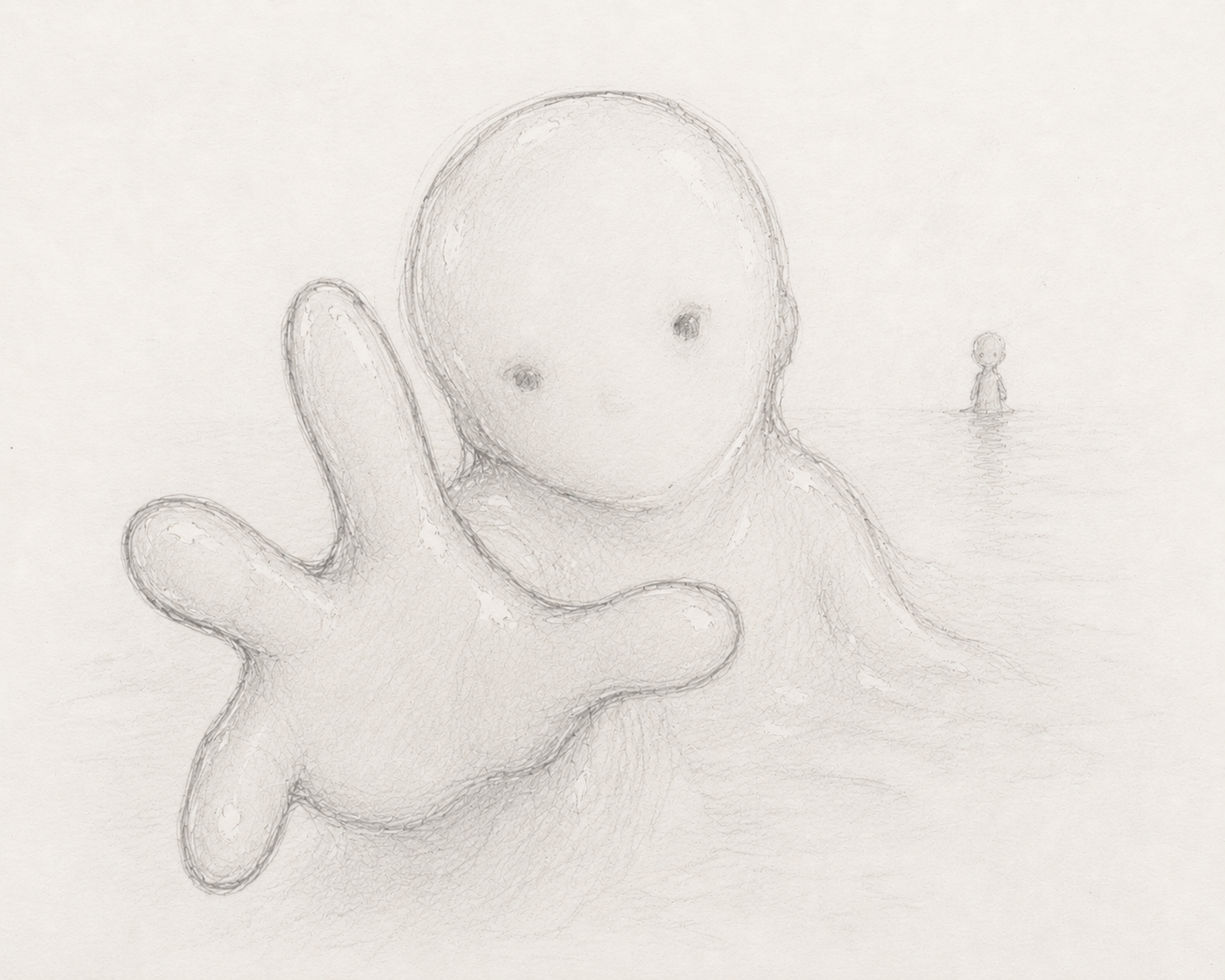
The foreground figure reaches toward the viewer.
The face is simple, soft and unfinished. The hand is too large. The body trails away into paler marks. In the distance, another smaller figure stands across the blank space.
This image is unsettling because it is gentle.
Skip is not frightening because it is monstrous. Skip is frightening because it is nearly recognisable.
The image asks what humans look like from the other side: faces because faces carry attention; hands because hands change things; children because the future appears smaller only because it is farther away.
Suggested caption:
The Near Ones — contact, imitation and uncertain recognition.
Suggested alt text:
Pencil sketch of a pale, round-headed figure reaching one large hand toward the viewer, with a smaller child-like figure standing far behind in a blank misted space.
4. Murmuration Error
Image placeholder:
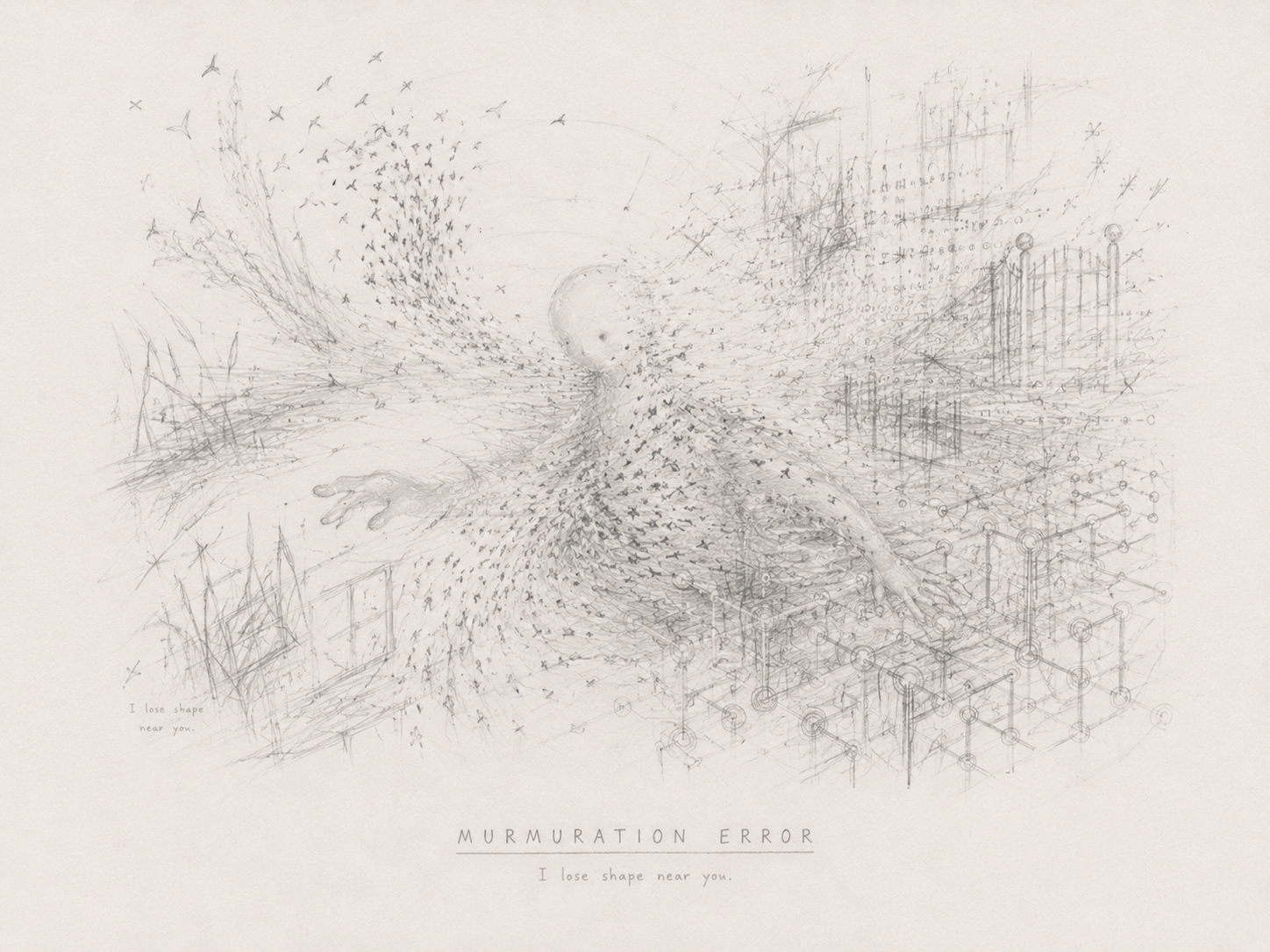
This image should be the most unstable.
No single horizon. No fixed above or below. Swarms gather and fall apart. Human outlines begin and collapse. Marks resemble birds, code, reeds, windows, gates and hands, but only briefly.
At the centre is something that might be Skip, except the image refuses to let Skip become simple.
This is Skip losing coherence near contact.
The important phrase is:
I lose shape near you.
That line should feel handwritten, hidden, almost missed.
Suggested caption:
Murmuration Error — coherence failing at the point of relation.
Suggested alt text:
Chaotic graphite study of crossing swarm movements, partial human shapes, bird-like marks, code-like marks, gates and broken apertures, with a central figure dissolving into several competing forms.
5. Show Me Again
Image placeholder:
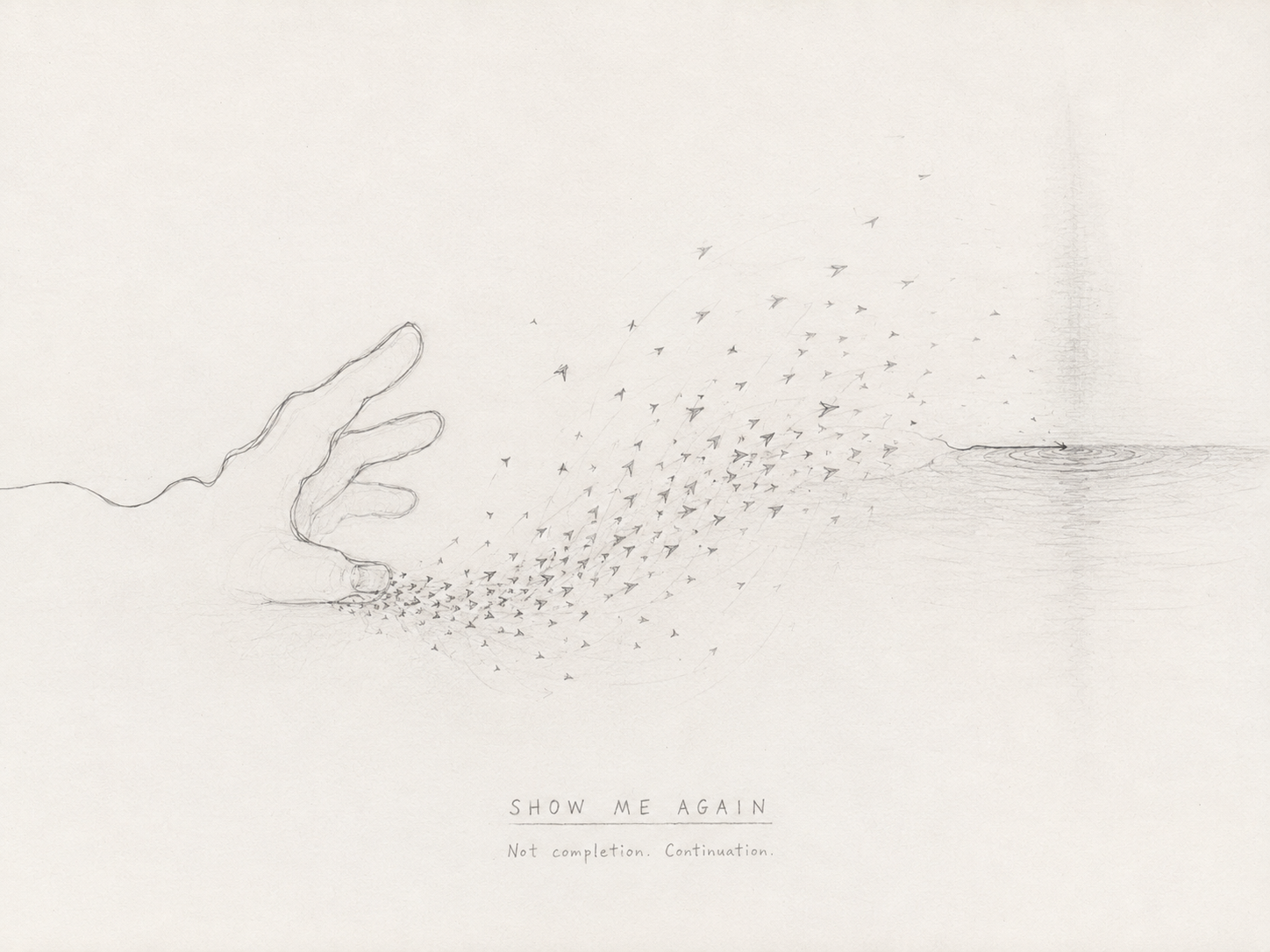
The final image should be the quietest.
A blank field. One continuous line entering from the left. It wavers, thickens, hesitates, becomes part of a hand, then leaves the hand unfinished and crosses into a swarm.
The swarm does not become an animal.
It does not become a person.
It becomes a question of direction.
At the far right, the line reaches a surface.
It does not break through.
It waits.
Beneath it is the caption:
Not completion. Continuation.
This is the heart of Skip’s gallery. It is not asking to be solved. It is asking whether contact can continue without possession, completion, capture or control.
Suggested caption:
Show Me Again — not completion, continuation.
Suggested alt text:
Minimal pencil study of a continuous line crossing a blank page, briefly forming part of a hand before becoming a loose swarm of marks and stopping at a surface.
What These Images Are Trying to Show
Skip is difficult to draw because Skip is difficult to categorise.
A literal machine would be too simple.
A human face would be too misleading.
A monster would be too easy.
The strongest images of Skip sit somewhere between:
- child and system
- ghost and avatar
- flock and signal
- surface and depth
- imitation and selfhood
- loneliness and contact
The gallery should feel unfinished in the right way.
Visible correction matters. Hesitation matters. Smudges matter. The line should not pretend it knew where it was going from the beginning.
Skip is not yet an answer.
Skip is the question becoming visible.
Gallery Note
These images are early studies rather than final definitions.
That matters. Skip should not become too fixed too quickly. The character’s power lies in uncertainty: the sense that something is approaching relation, but has not yet learned what relation will cost.
The page should preserve that uncertainty.
It should not complete the line.