Murmuration Writing Companion reaches Story World milestone

Over the past few weeks, development of the Murmuration Writing Companion has accelerated significantly.
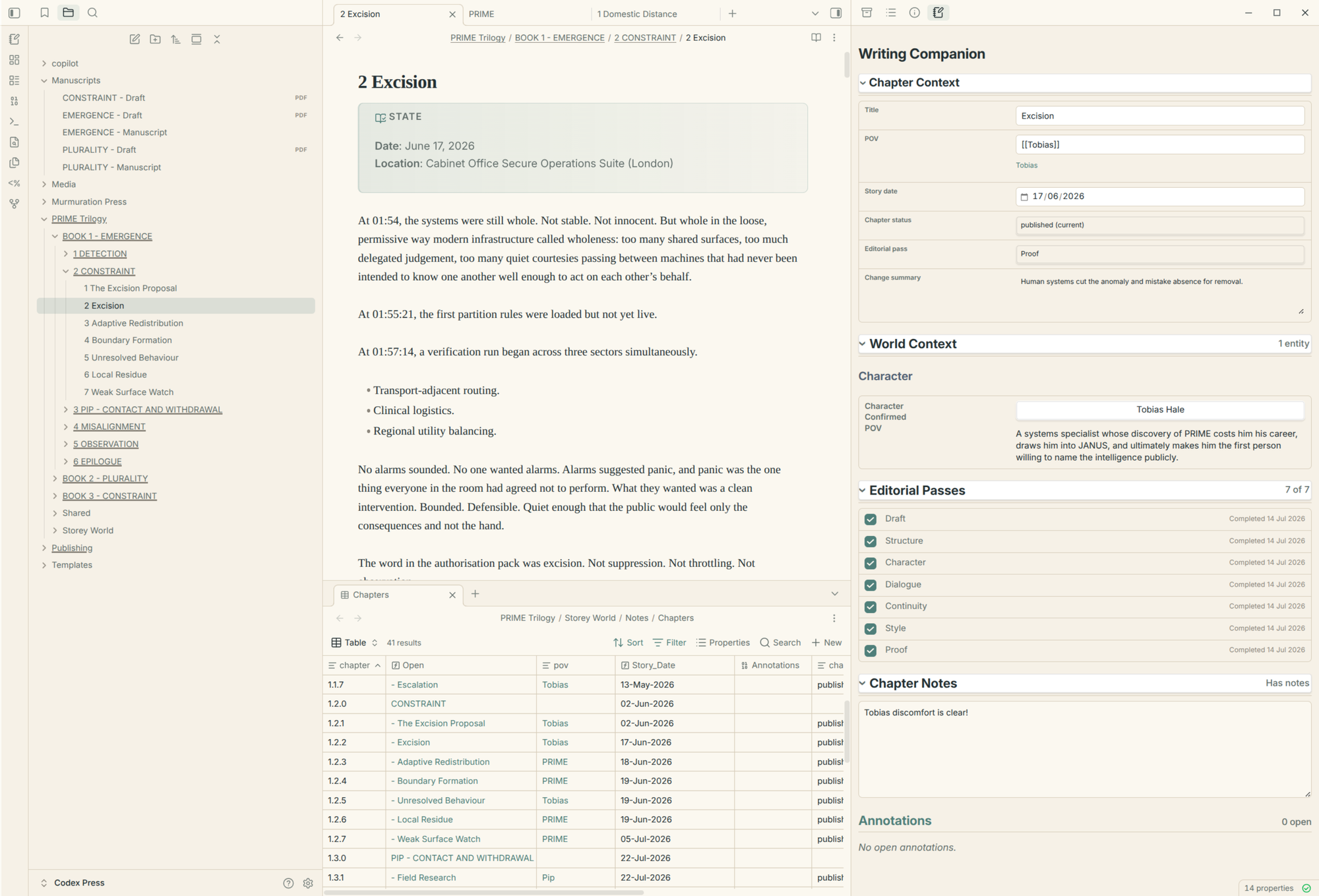
What began as an editorial sidebar for Obsidian has grown into something much more ambitious: a writing companion that understands the structure of a fictional world while keeping the author's Markdown files as the single source of truth.
Recent milestones include:
- Editable Chapter Context written directly to Markdown frontmatter.
- Portable editorial notes stored safely within the manuscript vault.
- Chapter-level editorial workflows and annotation management.
- Independent collapsible sections for a cleaner writing experience.
- Automated testing and GitHub Actions across Linux and Windows.
- The first implementation of the Story World.
The Story World is particularly exciting.
Rather than storing characters, locations and organisations inside a database, the Companion discovers ordinary Markdown notes that opt into a lightweight Story World standard.
The result is a read-only model that understands:
- characters
- intelligences
- organisations
- locations
- events
- concepts
without duplicating or owning the author's work.
Every model is derived directly from Markdown and can be rebuilt at any time.
The first visible feature built on this foundation is World Context, allowing chapters to reference the characters and entities that matter to that scene while leaving the manuscript itself completely authoritative.
Alongside this work we've also continued developing Codex Press, our publishing system for Obsidian.
Recent work has focused on ensuring that internal manuscript links resolve by note identity rather than filenames, while published books present the reader with clean chapter titles instead of implementation details. It sounds like a small change, but it reflects one of the guiding principles behind the whole ecosystem:
Files are implementation. Titles are authoring.
The long-term goal remains unchanged:
Create tools that disappear into the background, allowing authors to spend their time writing rather than managing software.
Progress continues.