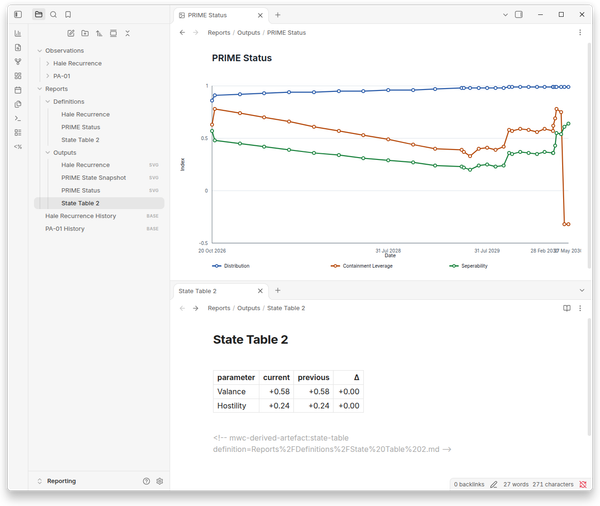
Murmuration Writing Companion 2.1 and Codex Press 1.0.1 Released

A major update to the Murmuration writing and publishing toolchain is now available, with both Linux and Windows support validated against real manuscripts.
We have released Murmuration Writing Companion 2.1 and Codex Press 1.0.1.
Together, the two Obsidian plugins now cover the workflow we originally set out to build: organise and understand a complex manuscript while writing it, then turn that manuscript into publication-ready PDF, EPUB and DOCX without maintaining a separate publishing source.
Murmuration Writing Companion 2.1 is released as plugin version 0.18.0. Codex Press is now at 1.0.1.
Murmuration Writing Companion 2.1
MWC 2.1 is the largest consolidation of the writing environment so far.
The most noticeable improvement is performance. Long scenes now remain responsive during ordinary editing, with substantially less unnecessary parsing and background work.
Story World integration has also become much more natural. Locations, POV characters and other manuscript context can be linked semantically while remaining readable in the interface. A Scene's Location can now contribute automatically to its derived World Context without adding duplicate metadata to the manuscript.
Manuscript chat is now a first-party Murmuration format rather than depending on a separate Obsidian plugin. Chat passages support the Markdown features needed by the books, including local images, while remaining part of the manuscript itself.
MWC 2.1 also adds:
- a substantially expanded author Help system;
- safer and simpler direct Git backup from inside Obsidian;
- improvements to Story World navigation and review;
- cleaner human-readable labels in place of internal paths and raw wikilink syntax;
- significant reductions in plugin bundle size and startup work;
- numerous continuity, manuscript-navigation and usability fixes.
The release was manually certified on both Linux and Windows as well as through the automated test suite.
Codex Press 1.0.1
Codex Press takes the same manuscript and produces PDF, EPUB and DOCX editions.
Version 1.0.1 is nominally a maintenance release, but the release process turned into a much more substantial validation of the publishing system.
Ordinary Obsidian links such as [[PRIME]] are now rendered as normal publication text rather than leaking Obsidian syntax into the finished book. Aliases and targeted links are handled correctly across PDF, EPUB and DOCX.
EPUB chapter handling has also been corrected. Chapters now have deterministic EPUB spine boundaries, preserving Part and chapter navigation without the blank-screen behaviour that some readers previously exposed.
During release certification, we also discovered that Mermaid's normal SVG output, although accepted by browsers, does not fully conform to the EPUB 3.2 rules checked by EPUBCheck. Codex Press now renders Mermaid diagrams to high-resolution transparent PNG for EPUB while retaining the existing PDF and DOCX paths.
The resulting MULTIPLICITY EPUB passes EPUBCheck with:
0 fatals, 0 errors and 0 warnings.
And, unexpectedly, Windows
We originally regarded Windows support for Codex Press as desirable rather than essential. The publishing pipeline depends on tools including Pandoc, XeLaTeX and Mermaid CLI, and cross-platform command execution can become complicated quickly.
During testing, we found one genuine Windows portability defect: npm command wrappers such as mmdc.cmd could be discovered successfully but failed when invoked by the publication process.
That problem is now fixed.
Codex Press successfully produced PDF, EPUB and DOCX on Windows from paths containing both spaces and Unicode characters, and the complete Windows automated suite passed.
As a result, Codex Press 1.0.1 is now supported and certified on both Linux and Windows.
Tested against real books
Both releases went through considerably more than automated unit testing.
The certification process included clean installations, application restarts, real publication workflows, Linux and Windows testing, EPUB validation, upgrade testing from the published Codex Press 1.0.0 release, and publication of real PRIME Trilogy material.
The files finally published to GitHub were then downloaded again and checked byte-for-byte against the versions that had actually been certified.
This may be rather more release engineering than is strictly sensible for two writing plugins, but it means the versions now available are the versions we actually tested.
Where this leaves the project
This is an important point for Murmuration Press.
The writing environment is no longer primarily an experiment built around the PRIME Trilogy. It is becoming a coherent toolchain in its own right:
Obsidian → Murmuration Writing Companion → Codex Press → published book
The PRIME Trilogy remains where the tools are developed and tested, which is exactly the point. Problems are found in real manuscripts rather than demonstrations constructed to make the software look good.
With MWC 2.1 and Codex Press 1.0.1 released, development can move back towards writing for a while.
[Download Murmuration Writing Companion]
Both projects, documentation and release notes are available through the Murmuration Press GitHub repositories.