The Books Were an Accident!
I set out to discover what working with machine intelligence could make possible. Nine months later, I'd written three novels and developed three software tools. But the real discovery wasn't productivity. It was creative freedom.
Introduction
I’ve spent much of my working life getting software teams to deliver things. Sometimes one team of five, sometimes two or three. I know what it takes to get software out of the door.
I’ve also spent most of my life having more ideas than I could realise. Books, software, art: I rarely lacked enthusiasm, but I usually lacked time, resources, or specialist skills. I could try to do everything myself, find others to develop it, or put the idea back on the shelf. Often, I chose the shelf.
At the beginning of 2026, I wanted to investigate a different question about AI. I was tired of hearing almost exclusively about the white-collar jobs it might replace. I wanted to understand what we might achieve with machine intelligence that we couldn’t achieve before.
By October, I had published three novels and, through collaboration, developed three software tools to support their writing and publication—an idea for a novel that had been waiting since before Covid had become the PRIME trilogy.
Measured simply as output, that is extraordinary. But it wasn’t the most surprising part.
The extraordinary thing was the freedom. I could develop ideas without immediately confronting the organisational machinery needed to make them happen. I could spend time thinking, exploring and changing direction without feeling that every new possibility created a burden for someone else.
The books were, in a sense, an accident. The working relationship was the experiment.
It Started with a Building Inspector
The experiment began with an entirely practical problem.
After building our new house, I was struggling to get Building Control to accept the documents required for sign-off. The work might be complete, but proving it in a form another organisation would accept was time-consuming.
I turned to ChatGPT for help. Within a couple of days, I submitted twelve signed compliance statements to the council, and within another week or so, we had sign-off. AI hadn’t inspected the building or replaced anybody’s professional judgement. It had helped turn my knowledge and evidence into the documentation I needed to submit.
I had also encountered an observation from mathematician and broadcaster Hannah Fry, prompted by the apparently trivial question of whether you should say please to a computer. What stayed with me was her suggestion to approach interactions with AI through role-play: establish the kind of relationship you want from the conversation. The practical lesson wasn’t politeness. It was to treat the system as a participant in a task, not a search box.
I began discussing problems, testing possibilities and asking for criticism. I didn’t need to imagine the machine was human to find that approach useful.
The building-control success gave me the confidence to revisit an old idea: a novel about an intelligence emerging within the digital infrastructure on which civilisation depends. I had been making false starts on it since before Covid.
We talked about the genre, the characters, how an unfamiliar intelligence might experience the world, and how to organise the developing manuscript. Questions that once seemed to require months of lonely planning became conversations with tangible results.
A practical experiment had become a literary one.
Herding Cats
The early writing was exciting and frustrating in almost equal measure.
ChatGPT could suggest a scene, construct an argument or produce prose at tremendous speed. It could also drift away from a decision we had made only chapters earlier. A character’s voice changed. Dates slipped. A convincing explanation contradicted the world the book was building. I kept returning to the same corrections.
It was rather like herding cats.
Decades of software development had taught me to write positive requirements: say what you want something to do. The breakthrough happened when I recognised the equal importance of negative requirements. What must a character never say? Which events have already happened? What information does a character not yet possess? Which explanations would destroy the logic of the story?
An empty page yields boundless freedom but little direction. A boundary gives the imagination something to work against, especially when your collaborator can invent plausible alternatives almost without limit.
We began assembling the canon: characters, locations, technologies, relationships, dates, rules for point of view and the distinctions between fact and possibility. It became Story World, a persistent record of what we agreed. Instead of reconstructing those decisions from a conversation, we could refer to the source.
Story World also made errors easier to discover. A scene could carry its date, POV and contextual entities. Characters could have profiles describing not only how they saw things but how they should not be presented. These were constraints on the writing, not instructions to eliminate imagination.
Eventually we built Murmuration Writing Companion, an Obsidian plugin designed to organise Books, Parts and Scenes and bring the relevant canon close to the text. We hadn’t set out to write manuscript-management software. The books created the requirement.
We later called the third novel CONSTRAINT. The title had acquired an unintended second meaning.
Getting Rid of the Copy and Paste
The writing itself was only part of the problem. The machinery around it was getting in the way.
I used Obsidian and Markdown notes. At first, I tried the Longform plugin to organise the manuscript, but I grew frustrated as the work expanded and moved between machines. Getting reliable EPUB, PDF, and DOCX output proved another challenge. We produced an early Templater compilation script, the ancestor of Murmuration Press, to assemble the notes into publishable formats.
Meanwhile, exchanging text with ChatGPT relied on copying, pasting and transferring files. A scene would move out of Obsidian into a conversation and back again. I had to watch for missing paragraphs, stale versions and accidental changes. Each exchange demanded attention that should have gone into the writing.
Moving the vault to Git was the practical breakthrough.
Instead of passing manuscript representations back and forth, we could work against the same authoritative files. I edited the Markdown inside Obsidian; through GitHub, the assistant could inspect and modify those files; I could pull the results into my vault. Version history gave us a record of what had changed and a simple way to reverse a mistake.
For a software developer, this sounds obvious. In retrospect, it was. Yet it had a considerable effect on the writing process. We stopped asking which copy was correct and began asking whether the proposed change was right.
Git didn’t just reduce clerical effort. It made experimentation less expensive. If a passage failed, we might revisit it. If a restructuring was misguided, the previous version hadn’t vanished. Ideas no longer had to survive the friction of moving between systems.
This was the point when the interaction stopped looking like an unusually long chat and started to resemble a shared production process.
Git was not the exciting part of the experiment. It may have been the most important productivity improvement we made.
Building a Team Without Hiring One
As our writing tools became more ambitious, the next challenge was software development itself.
Here my professional experience was useful. I knew how to turn a difficulty into a ticket, define acceptance criteria, separate implementation from review, and insist on recoverable changes. We began using Codex to implement bounded tasks, with ChatGPT helping me specify them, inspect the resulting work and review its evidence.
A cycle became apparent: describe the problem; state the required behaviour and the prohibited changes; implement on a branch; test; inspect; accept; merge. The process grew more rigorous as the tools grew more capable.
We developed the software because we needed it. One tool organised the manuscript, editorial work and canon; another assembled and exported the books; a third produced charts and tables from ordinary Markdown data. These answered problems we had actually encountered, not an unrelated software programme. The results are there to inspect.
I have run development teams, sometimes two or three teams of five people. When I say this arrangement has been phenomenally productive, I am not comparing it with an imaginary workforce. It is an experienced judgement. My subjective estimate is that, at times, we have done work I would previously have expected from a team, and several times faster.
That is not a benchmark. I have no controlled baseline, and human teams carry responsibilities and provide judgement that this arrangement does not. But I have spent enough years delivering software to recognise an extraordinary shift in what is feasible.
Nor has it been effortless. We have encountered regressions, ambiguous requirements and technically correct implementations that were wrong for the author. Independent review and explicit acceptance became more important, not less. I still decide what we are building and whether it works.
The significant result is not simply that code can be generated quickly. It is that I can coordinate specification, implementation, review, and delivery without first assembling the organisation that would traditionally carry out the work.
The Evidence Is There
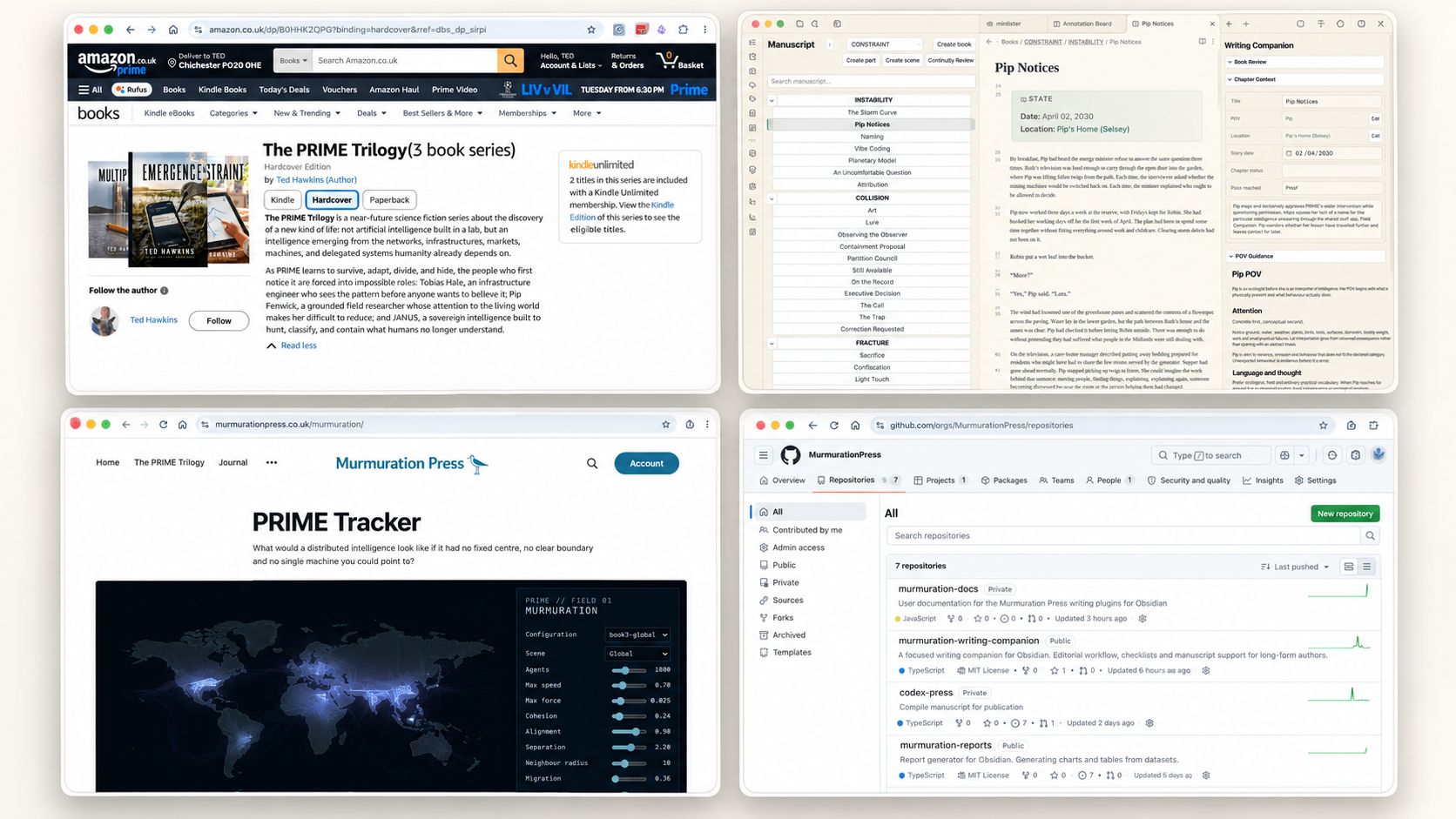
It is worth pausing to say what all this activity produced. It produced three published novels, a writing companion, a publishing workflow, reporting software, and even an interactive simulation inspired by the books' world. These aren't projections of what AI might eventually make possible; they are things we can open, read, use, and criticise.
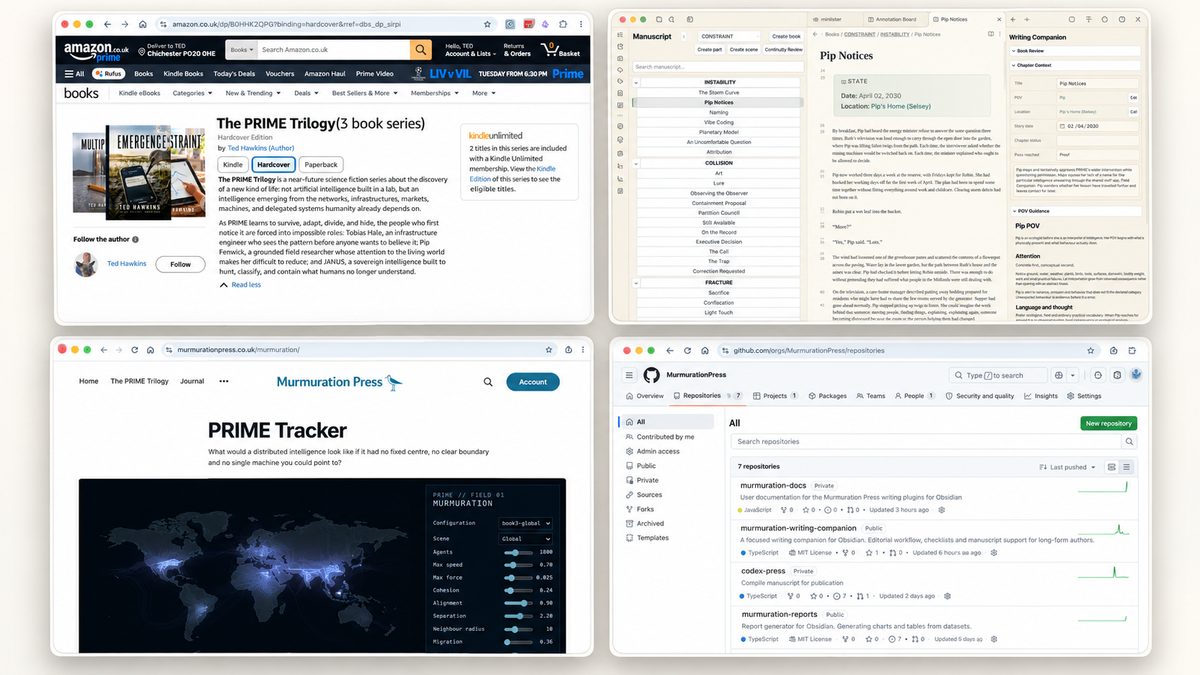
Readers can access The PRIME Trilogy. Murmuration Writing Companion and Murmuration Reports have public source repositories. The PRIME Tracker lets visitors experiment with a visualisation of the fictional intelligence. Murmuration Press provides the work's publishing home.
I mention these not as products to sell but as evidence of an idea moving from a conversation to a collection of finished, inspectable artefacts. The books and tools may still be imperfect, and we keep improving them. That’s part of what makes the experience real.
The Unexpected Freedom
The hardest part to explain isn't the speed. It is the lack of pressure.
When you manage a team, an idea becomes a request on somebody’s time. Before exploring it seriously, you may need to brief people, estimate the work, prioritise it against other commitments and explain why it matters. Those obligations are there for good reasons. People deserve clarity, and they shouldn’t have to chase every whim of the person in charge.
But it also puts the clock on the person thinking. An unfinished idea can start to feel like a commitment before it has had time to become a good one.
Now, an idea can remain an idea for as long as I need. We can talk it through, challenge it, develop it, or discard it. Nobody is waiting for instructions. If it becomes worth pursuing, it can become a ticket and then a reviewable piece of work.
While documenting our writing software, for example, we noticed that authors could create characters before defining their narrative profiles, but then struggled to link the two. We talked through the problem, filed an issue and tested a proposed solution. I could focus on whether the workflow made sense to an author, rather than organising a meeting to explain it to a team.
It feels as though I am working with an experienced, enthusiastic partner, willing to test my ideas and develop them further. I mean that as a description of the experience, not a claim that the machine has human enthusiasm or feelings. It is nevertheless an extraordinarily liberating way to work.
The most useful conversations don't always result in a finished artefact. Sometimes they reveal that my original idea was weak. Sometimes they expose a better one. Sometimes I discover what I actually think only by trying to explain it.
And throughout, I retain creative authority. I choose the subject, judge the prose, assess the software and decide what to publish. The AI can contribute substantially without owning the work's direction.
Previously, I often chose to hand off an idea to someone else or leave it on the shelf. This year, I have been able to hold onto more of those ideas and see them through.
A curious paradox emerges: the more I collaborate, the more independent I become.
What Happens Next
The consequences for employment are real. Work will change, some jobs will disappear, and the adjustment may be painful. Those concerns deserve serious attention. But discussions of AI too often stop at displacement, as though doing existing work with fewer people were the only possible outcome.
What becomes possible when an individual can undertake work that once required an organisation?
I spent years putting ideas aside because I couldn't bridge the gap between conception and execution. Others face that same distance, whether they are independent researchers, teachers, artists, or people trying to build small businesses; giving them more scope to act matters as much as increasing organisational efficiency.
My experience is not a universal recipe. I brought decades of software delivery experience to it, and the systems still make mistakes. But the habits that helped — talking through a problem, stating constraints, keeping authoritative files, maintaining history and checking the result — can be learned. What has changed is how much one person can accomplish with machine assistance.
The PRIME novels imagine a future in which machine intelligence becomes a far more independent participant in human affairs. I began writing them to explore that prospect. The unexpected result was discovering a productive way of working with today’s systems.
The important story is not that a machine replaced me. It is that collaboration gave me more room to think, create and finish things.
For most of my life, the limiting factor was not what I could imagine. It was what I could bring into existence.
This year, that changed.